Search Mami Mozart

AFFORDABLE INSTRUMENTS

Showing posts with label Paint. Show all posts

April 27, 2015

Kids and Art - Fun and Easy Watercolor Secrets

Kids and Art - Fun and Easy Watercolor Skills 

Try some of these easy and fun watercolor skills in the classroom or home. 
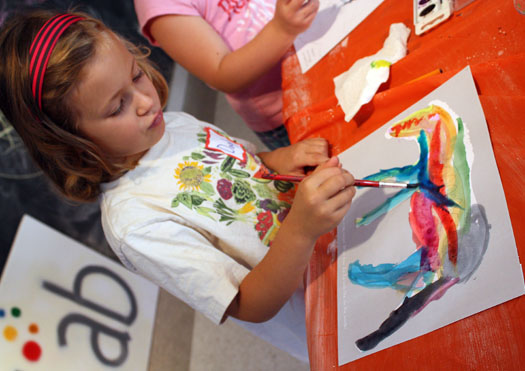
Watercolors are a fun and easy medium for kids and adults alike. Parents and teachers can easily clean up watercolor messes, and children enjoy the easily accessible paints. Watercolors are portable, too, and are usually less expensive than other painting and drawing mediums. Try some of these easy watercolor techniques next time you and your child or students are creating art with watercolors.

Wet on Wet Technique
Try a little art experiment. Fold a large piece of white paper in half. Wet one half with a water using a brush and leave the other half dry. Now the kids can experiment with the differences between wet brush on wet paper and wet brush on dry paper. Discuss the differences together and figure out when such a technique would be appropriate (painting a lake, for example, or a mist). You can also experiment with a drier brush on both the wet and dry sides of the paper.

Etching into the Paint
Texture can be added to a painting by using a sharp tool (ex. a toothpick, pencil, or paper clip) to etch in blades of grass, waves, hair, or hundreds of other texture ideas. Be sure to emphasize the importance of lightly etching in order to avoid making holes in the paper.

Taping
Use painter's tape (or inexpensive masking tape) to block of sections of the paper that will remain white afterwards. Artists use tape to keep sections pure white, to keep lines straight, or to keep colors from bleeding into other colors. One fun project is using small bits of tape all over a white sheet of paper. Paint the paper a dark blue or black for the night sky. Afterward, remove the tape, and suddenly the white spots become stars.

Blotting
Children should always have a few pieces of paper towels or napkins by their art station. Not only is this convenient for spills, but students can use bit of napkin to lighten dark colors or even make mistakes disappear through blotting. Napkins dipped a little bit in paint also provide a tool for creating foliage and texture in art pieces.

Blending Colors
Most consumer watercolor palettes are plastic. When you open the watercolor palette, the underside of the lid is usually sectioned off into shallow spaces. These small sections can be used to mix watercolor paints without changing the integrity of the original color. Try creating an orange-red with your child or class. Wet the soft bristle brush and dip it into the red. Dab some of the red paint into one of the empty sections. Wash the brush thoroughly, and dip the brush into the orange. Now mix the orange paint with the red paint. You have created an orange-red color without mixing up the original color palette. This is especially useful with lighter paint, such as yellow or white.

April 7, 2015

Art and Kids: 4 Incredibly EASY Collage Art Projects

Art and Kids: Top 5 Tips Making a Collage 

Children love creating art. Using recyclables, magazines, knick-knacks, and glue, your child or class can create amazing collage projects. 

Whether you are an art teacher on a low budget or a parent just looking for something creative to do with your child, making art through collage is a fun, easy, and exciting activity. Old magazines, fabric scraps, yarn, buttons, paperclips, bottles, or even soda caps can be transformed into art. Try some of these fun activities below.

Collage Self-Portrait
Materials: Large paper, crayons or markers, yarn, magazines, string, odds and ends, glue, scissors
Have your child or class draw the outline of a face big in the center of the paper/cardboard. Now, using all of the materials collected, have the kids recreate their face, hair, eyes, nose, mouth, eyebrows, and clothing. Don't forget accessories like glasses, jewelry, and hats. The portrait does not need to be realistic. Encourage creativity over accuracy for some zany portraits.

Ancient Shield
Materials: Large piece of cardboard, glue, cardboard strips, paper clips, soda cap lids, aluminum paper, coins, buttons, any sort of metal objects, scissors, glue, rope/string
First the child must cut the cardboard in a shape suitable for a shield. An adult can help with this, depending on the age of the child. Using all of the recycled materials, decorate the shield. Look up some images of shields online, and decide on whether it will have a crest, designs, symbols, or any unique features. For holding the shield, you can hot glue or staple strips of cardboard to slip the arm in or cut out four holes and thread string through the openings.

Recyclable Bird Feeder
Materials: Large milk or juice cartons, glue, scissors, rope or string, paint or markers
Drain and clean out the carton. Cut a square on the side of the carton, near the bottom edge. Hole punch two holes through the top lids of the carton and thread through rope or heavy string. Now the bird feeder is ready for decorating. Students can paint the carton like a little house using acrylics (which will not wash away) or by using permanent markers. While some small materials can be glued on the feeder for decoration, the birds may pick at decorations. Fill the carton with birdseed and hang on a tree limb in a relatively dry place. Be sure to test the tree limb and string for weight.

Paper Mache' Animal Sculpture
Materials: Boxes, bottles, newspaper or scrap paper, masking or duct tape, bowls, water, glue (lots of it!), scissors, paint, brushes, pipe cleaners, buttons
Paper mache' is messy, but a lot of fun! First, tape the boxes and bottles in the shape of your child's animal. Make sure the body is thick without any really small parts (like thin tails, whiskers, or antennae). Next, cut the newspaper into 1" strips of varied length (4" to 6"). Have the kids dip the strips, one at a time, in watered down glue in bowls and cover the bottle/box sculpture until the entire sculpture is covered. If there are enough strips, apply a second coat of strips. Wait three days to let the paper mache' to dry entirely (or less time if there is a fan on them). When they are dry, use acrylic paint to create the animals. Use pipe cleaners, buttons, string, and other materials to add the finishing touches.

October 6, 2014

How Art Improves Your Child's Development: Creativity and Children

How Art Improves Your Child's Development: Creativity and Children

Art improves a child's development on several different levels, 
not least of which is the encouraging of creativity and problem-solving.

Many studies have been done in the past two decades regarding the importance of art and creativity in the development of children. Working extensively in the arts (visual art, music, and theater) with at-risk youth these past eight years, I have come to realize that visual art activities work on several important skills in a child's development.

Encouraging creativity
When creating an artistic work, whether it is a crayon drawing on a wall or a developed self-portrait, a child is learning to communicate visually. Maybe they are only drawing what happened that day ("mommy and me at the zoo"), or maybe they are communicating something deeper ("today the cat died and this is me sad"). Many times, young children are only learning to experiment ("red paint and blue paint mixed together make a new color") or learning how to properly use an art tool. Creativity is an important skill that is invaluable at school, in the workplace, and in everyday life.

Increasing fine motor skill function
Whether learning how to cut properly with scissors for the first time, learning how to draw, or attempting to control a paintbrush's strokes on a canvas, a child can learn intricate fine motor skills through the arts that is invaluable to future success.


Developing problem-solving skills
A child wants to recreate a happy memory visually. These thoughts may run through the child's head, "Should I use crayons, pencils, or magazine cut-outs? What kind of paper should I use? The glue is not working properly, what will work better?" Art encourages basic and advanced problem-solving skills in a variety of contexts.


Encouraging self-expression
A kindergartner expresses his happiness through a cheerful painting of flowers and sunshine, a misunderstood teen communicates his frustration through a series of morose drawings, or a young cancer patient paints her visions of heaven. Each example shows a child learning to portray visually what can not be said through words or actions. Self-expression is an important human trait manifested in the visual arts.

EXCLUSIVE 5 BOOK KINDLE KIDS PICTURE BOOK BUNDLE 

An effective form of therapy for troubled youth
Many times when dealing with a student that exhibited uncontrollable anger, I invited the child to draw their feelings on a piece of paper. The student would angrily scribble out his/her emotions in bold strokes of red and black. Abused and neglected children often express their experiences through visual art. Art therapy also aids in dealing with grief, depression, and abandonment issues. Of course, in all cases, if a child or teen regularly exhibits disturbing visual imagery, a professional should be consulted immediately.

Multicultural art activities encourage the acceptance of others 
Children can learn about other cultures in a safe and age-appropriate manner through the use of fun multicultural arts activities. Whether its sewing a set of Latin American worry dolls, learning Japanese calligraphy, exploring aboriginal dream paintings, or creating Haitian metal sculptures, you and your child can explore exciting faraway worlds together through engaging arts activities.

----

Award-winning composer and media artist Sabrina Peña Young has over fifteen years educational experience, from early childhood to graduate school. She currently teaches humanities courses online and will be speaking at the upcoming TedX Buffalo October 14, 2014 on her animated operaLibertaria: The Virtual Opera, an excited online sci-fi opera about the teen rebel Libertaria escaping from a genetics Factory and teaming up with her addict father to destroy evil reverse-aging geneticists in a post-USA dystopia. 


Young is the author of the Mama Young children's book series for Kindle. Check out Baby Shoes and other engaging children's picture books for the young child.